Last month we reported that members of the Transportation Infrastructure and Planning Committee attended the Canadian Parks and Wilderness Society’s Forum. Since then, we have also attended two events hosted by the National Capital Commission:
- The NCC Urbanism Lab
- The first meeting of the NCC Public Advisory Group (PAG)
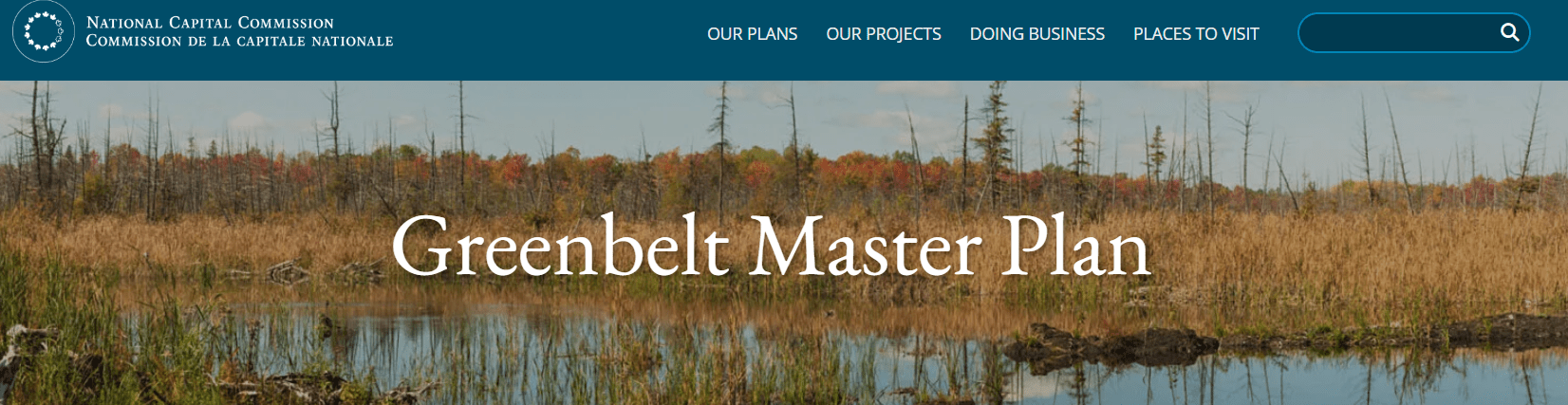
The Greenbelt Master Plan
It’s an important year for the Greenbelt. The National Capital Commission is reviewing the Canada’s Capital Greenbelt Master Plan. (The NCC says that they will be seeking public input on the vision for the future of the Greenbelt beginning in 2026. To stay informed about each phase of public engagement, you can sign up for NCC newsletters.)
The NCC Urbanism Lab
The NCC Urbanism Lab, open to anybody, but held in-person, downtown in the middle of the day, March 25, was a presentation by the NCC of their starting point—a sort of setting of the table. After an introduction to the event by Alain Migulez, Andrew Sacret, Chief of Planning and Design at the NCC, took over as moderator. It was not lectures, more a question-and-answer format. None of the guests are currently employees of the NCC. The guests were:
- Trina Mather-Simard, CEO of Mādahòkì Farm, on Hunt Club Rd between Highway 416 and Moodie Drive. Mādahòkì Farm has taken over from Victoria Island as a site for Indigenous cultural practices and tourism.
- Richard Scott, Senior Planner, Parks Canada. He began his planning career working as project manager for the 1996 Greenbelt Master Plan, worked on the Trent–Severn Waterway, then from 2012 to 2020 on the planning of the new Rouge National Urban Park on Toronto’s eastern outskirts.
- Leanna Wigboldus, PhD, Heritage Contractor, lead researcher at Spaces. She has collaborated with national and international heritage organizations and academic institutions including the International Council on Monuments and Sites (ICOMOS), the International Centre for the Study of the Preservation and Restoration of Cultural Property (ICCROM), the International Union for Conservation of Nature (IUCN) and the Canadian Association of Heritage Professionals (CAHP).
The event was informative. The messaging seemed to be that:
- Ottawa is lucky to have the Greenbelt
- The Greenbelt was protected on purpose, unlike the Rouge National Urban Park which only narrowly survived and had to have people fight for it.
- The land is better protected by the NCC, and a national urban park is not required here. We can relax. Everything is taken care of.
- There are different kinds of Greenbelt
- Flexibility is good. Have an open mind.
- Humans (that is recreational, commercial and agricultural enterprises) and nature can coexist. There’s no conflict.
- The Greenbelt will probably keep some of the wetlands like Mer Bleu.
- Cultural heritage (tourism and entertainment) is good.
The first meeting of the NCC Public Advisory Committee
Membership in the NCC Public Advisory Committee (PAG) is by invitation only and is limited to one representative per organization. Ian McConnachie is representing CBLCA.
CBLCA was not initially invited, but Kate MacNeil of the Ottawa Carleton Wildlife Centre (OCWC) told us about it and we asked to be included. The PAG seems to comprise community associations near the Greenbelt, and various environmental organizations such as:
- Community Associations for Environmental Sustainability (CAFES)
- Canadian Parks and Wilderness Society (CPAWS)
- Ecology Ottawa
- Greenspace Alliance (GA)
- Ottawa Carleton Wildlife Centre (OCWC)
Members commit to a 24-moth term with the possibility of renewal. PAG members will act as the primary point of contact for their organization and will help facilitate knowledge-sharing and communication with members of their community regarding public consultation activities.
The first meeting was held in Cyrville, April 9 for introductions and a discussion of the Terms of Reference.
What’s next?
The next step is for the PAG to review and sign the Terms of Reference. The next meeting, which will focus on the vision and guiding principles, is scheduled for Monday, May 4. The finalized document, along with the list of representatives, will then be published online.
Leave a Reply